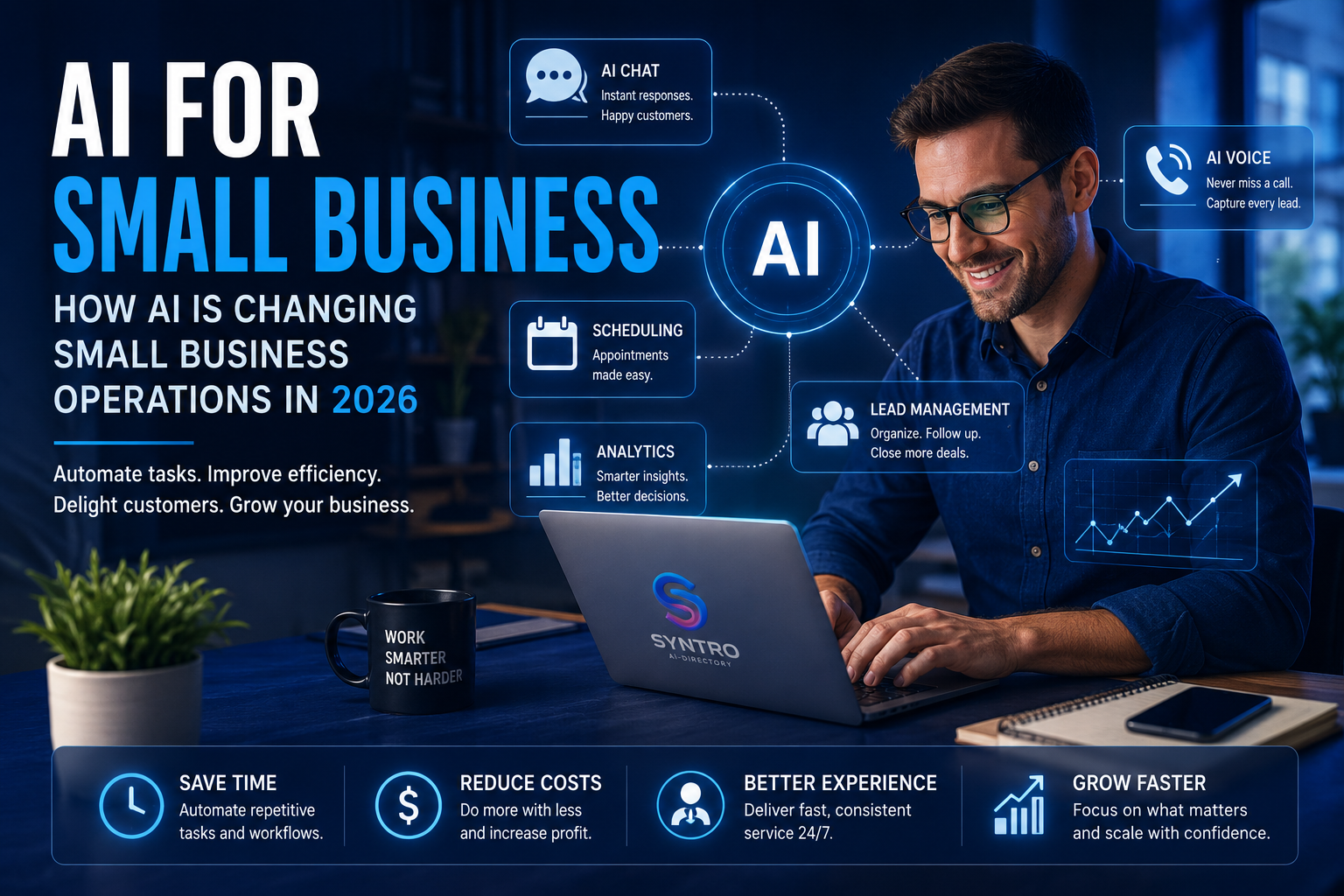
How AI Is Changing Small Business Operations in 2026
Artificial intelligence has quickly evolved from a futuristic concept into a practical business tool. What once seemed accessible only to large corporations is now being used by businesses of every size to improve efficiency, enhance customer experiences, and streamline daily operations.
For small businesses in particular, AI is creating opportunities that would have been difficult to imagine just a few years ago. Tasks that once required multiple employees, countless hours, or expensive software systems can now be automated, simplified, or assisted by intelligent technology.
As we move through 2026, the businesses that understand how to leverage AI effectively are finding new ways to save time, improve responsiveness, and create better customer experiences.
The question is no longer whether AI will impact small businesses.
The question is how businesses will choose to use it.
AI for Small Business – The Evolution of Business Technology
Technology has always influenced how businesses operate.
From accounting software and email communication to websites and online marketing, each advancement has helped organizations become more efficient and connected.
Artificial intelligence represents the next major step in that evolution.
Unlike traditional software that simply follows instructions, AI can analyze information, generate responses, identify patterns, and assist with decision-making.
This allows businesses to automate processes that previously required human intervention.
Rather than replacing business owners or employees, AI often serves as a powerful assistant that helps teams accomplish more with the resources they already have.
Customers Expect Faster Responses
One of the most significant changes influencing businesses today is the expectation of immediate communication.
Customers no longer expect to wait several days for a response.
Many people expect answers within minutes.
Whether someone is requesting a quote, asking about services, or seeking additional information, response speed often influences purchasing decisions.
Businesses that respond quickly tend to create stronger first impressions.
The challenge is that many small businesses operate with limited staff and cannot monitor inquiries around the clock.
AI-powered communication tools help bridge that gap by providing immediate engagement even when business owners are unavailable.
Reducing Administrative Work
Administrative tasks consume a surprising amount of time.
Scheduling appointments, responding to common questions, managing inquiries, collecting customer information, and organizing communication can easily occupy several hours each day.
While these activities are important, they often prevent business owners from focusing on growth-oriented work.
AI automation helps reduce repetitive administrative responsibilities.
Instead of manually handling every interaction, businesses can automate common workflows while maintaining a professional customer experience.
This creates more time for revenue-generating activities and strategic planning.
Better Lead Management
Many businesses lose opportunities simply because inquiries are not handled consistently.
A customer may submit a form after business hours.
Someone may call during a busy period.
A potential client may request information while employees are occupied elsewhere.
Without a system in place, opportunities can be delayed or overlooked entirely.
AI-driven systems help businesses respond immediately, gather important information, and guide potential customers through the early stages of communication.
This creates a smoother experience for prospects while improving lead management for business owners.
Supporting Rather Than Replacing Employees
One of the most common misconceptions surrounding AI is that it exists solely to replace human workers.
In reality, many successful implementations focus on support rather than replacement.
AI handles repetitive tasks.
Employees focus on relationships, creativity, problem-solving, and expertise.
For example, an AI system may answer common questions, qualify leads, or schedule appointments.
The business owner or team member then steps in when personalized assistance is required.
This partnership allows businesses to operate more efficiently without sacrificing customer service.
Improving Customer Experiences
Customers value convenience.
They want answers quickly, processes to be simple, and communication to be clear.
AI tools help businesses meet these expectations by providing:
- Faster responses
- Consistent communication
- Improved availability
- Streamlined customer interactions
When implemented thoughtfully, automation enhances rather than diminishes the customer experience.
The goal is not to remove the human element.
The goal is to eliminate unnecessary friction.
AI Is Becoming More Accessible
Not long ago, advanced automation required large budgets and specialized technical expertise.
Today, many AI-powered tools are designed specifically for small businesses.
Solutions are available for:
- Customer communication
- Lead management
- Appointment scheduling
- Marketing automation
- Content creation
- Customer support
This accessibility allows businesses of all sizes to benefit from technologies that were once available only to large organizations.
The Competitive Advantage of Efficiency
Small businesses often compete against larger companies with greater resources.
Efficiency becomes a significant advantage.
When routine tasks are automated, business owners can focus more attention on:
- Customer relationships
- Service quality
- Business development
- Strategic growth
The result is often a more agile and responsive organization.
Businesses that operate efficiently are better positioned to adapt to changing customer expectations and market conditions.
Preparing for the Future
Artificial intelligence is not a temporary trend.
It represents a fundamental shift in how information is processed, communication is managed, and business operations are conducted.
Companies that begin exploring AI today are building familiarity and experience that will benefit them in the years ahead.
The goal is not to automate everything.
The goal is to identify opportunities where technology can create meaningful improvements.
Small, strategic implementations often produce significant results.
Final Thoughts
Artificial intelligence is changing the way small businesses operate by helping owners save time, improve responsiveness, and create better customer experiences.
From lead management and customer communication to administrative efficiency and workflow automation, AI is becoming an increasingly valuable business tool.
The businesses that thrive in the future will not necessarily be those with the largest budgets.
They will be the businesses that learn how to use technology effectively while continuing to provide exceptional service.
AI is not replacing small businesses.
It is helping them compete, grow, and operate more efficiently than ever before.
If you are not listed, get listed HERE