
Category: AI Authority Signals

  • Why Businesses Miss Leads After Hours and How Business Automation Is Changing the Game

    Table of Contents

      Why Businesses Miss Leads After Hours and How Business Automation Is Changing the Game

      Every business owner understands the value of a new lead.

      Whether it arrives through a phone call, website form, social media message, or online inquiry, every opportunity represents a potential customer actively seeking a solution.

      Yet many businesses unknowingly lose leads every day.

      Not because their services are poor.

      Not because customers lose interest.

      But because no one responds when the inquiry arrives.

      In today’s digital world, customer expectations have changed dramatically. People want answers quickly, and they often reach out when it is convenient for them—not necessarily during normal business hours.

      This creates a challenge for small businesses that cannot monitor every communication channel twenty-four hours a day.

      The result is a growing gap between customer expectations and business availability.

      Fortunately, automation is helping businesses close that gap.

      Modern Customers Operate on Their Own Schedule

      Business owners often think of operating hours as the primary window for customer communication.

      Customers think differently.

      People search for services at night.

      They browse websites on weekends.

      They submit quote requests during lunch breaks.

      They send messages while watching television.

      The reality is that customers begin their buying journey whenever they have a need.

      That means opportunities can appear at any hour of the day.

      Businesses that rely solely on traditional office hours may miss important interactions before they ever begin.

      Speed Influences Decisions

      Numerous studies have shown that response time plays a major role in customer decision-making.

      When a potential customer reaches out to multiple businesses, the first company to respond often gains a significant advantage.

      A fast response creates confidence.

      It signals professionalism.

      It demonstrates attentiveness.

      Most importantly, it keeps the conversation moving forward.

      When responses are delayed for several hours—or even until the next business day—customers frequently continue their search elsewhere.

      The opportunity may not disappear because of pricing or service quality.

      It may disappear simply because another business responded first.

      The Hidden Cost of Missed Calls

      Phone calls remain one of the most valuable lead sources for many businesses.

      Unfortunately, missed calls happen.

      Employees are helping customers.

      Owners are in meetings.

      Teams are on job sites.

      Voicemail often becomes the default response.

      While voicemail still has value, many customers prefer immediate engagement.

      If a missed call is not followed up quickly, the prospect may move on to the next option.

      For businesses operating in competitive markets, every missed call can represent lost revenue.

      Website Forms Are Not Always Enough

      Website forms are an important lead generation tool.

      However, many businesses assume that receiving a form submission automatically solves the communication problem.

      In reality, forms only capture information.

      Someone still needs to respond.

      If form submissions sit unread for hours, customers may feel ignored or uncertain about the next step.

      The expectation gap continues to grow.

      People increasingly expect confirmation that their inquiry has been received and that someone will follow up promptly.

      Automation helps provide that reassurance immediately.

      The Rise of Instant Communication

      Modern consumers have become accustomed to instant communication.

      Messaging apps, social platforms, and online services have conditioned users to expect quick responses.

      This expectation has extended into the business world.

      Customers often want answers before they commit to making a phone call or scheduling a consultation.

      Businesses that provide timely engagement create smoother customer experiences and reduce friction throughout the buying process.

      The faster a business can acknowledge an inquiry, the greater the likelihood that the conversation will continue.

      How Automation Helps Businesses Stay Responsive

      Automation is not about replacing people.

      It is about ensuring opportunities are acknowledged even when staff members are unavailable.

      Automated systems can:

      • Respond to inquiries instantly
      • Confirm receipt of requests
      • Collect preliminary information
      • Route leads appropriately
      • Schedule appointments
      • Notify business owners of new opportunities

      This creates a seamless bridge between customer outreach and human follow-up.

      Instead of waiting hours for a response, prospects receive immediate engagement that keeps them connected to the business.

      Better Customer Experiences Begin Earlier

      Many businesses focus on customer service after a conversation begins.

      Automation improves the experience before the conversation even starts.

      A quick acknowledgment demonstrates professionalism.

      Clear communication reduces uncertainty.

      Immediate engagement builds confidence.

      Customers appreciate knowing that their request has been received and that the business is prepared to help.

      This simple interaction can significantly influence how the business is perceived.

      Small Businesses Can Compete More Effectively

      Large organizations often have dedicated staff available to handle inquiries throughout the day.

      Small businesses rarely have that luxury.

      Automation helps level the playing field.

      By providing consistent communication and rapid response capabilities, smaller companies can deliver experiences that rival much larger competitors.

      Technology allows businesses to extend their availability without dramatically increasing overhead costs.

      This creates opportunities for growth while maintaining operational efficiency.

      The Future of Lead Management

      Customer expectations will continue to evolve.

      Response times will become increasingly important.

      Communication channels will continue to expand.

      Businesses that rely solely on manual processes may find it difficult to keep pace.

      Automation provides a scalable solution that helps businesses remain responsive, organized, and customer-focused.

      The goal is not to remove human interaction.

      The goal is to ensure opportunities are never overlooked simply because they arrive at inconvenient times.

      Final Thoughts

      Businesses lose leads every day due to delayed responses, missed calls, and limited availability.

      In many cases, the issue is not service quality or pricing.

      It is timing.

      Modern customers expect quick communication and immediate acknowledgment when they reach out for information.

      Automation helps businesses meet those expectations by ensuring inquiries receive prompt attention regardless of when they arrive.

      As customer expectations continue to evolve, businesses that embrace responsive communication strategies will be better positioned to capture opportunities, improve customer experiences, and grow more effectively.

      The companies that win future business may not always be the largest.

      They may simply be the ones that respond first.
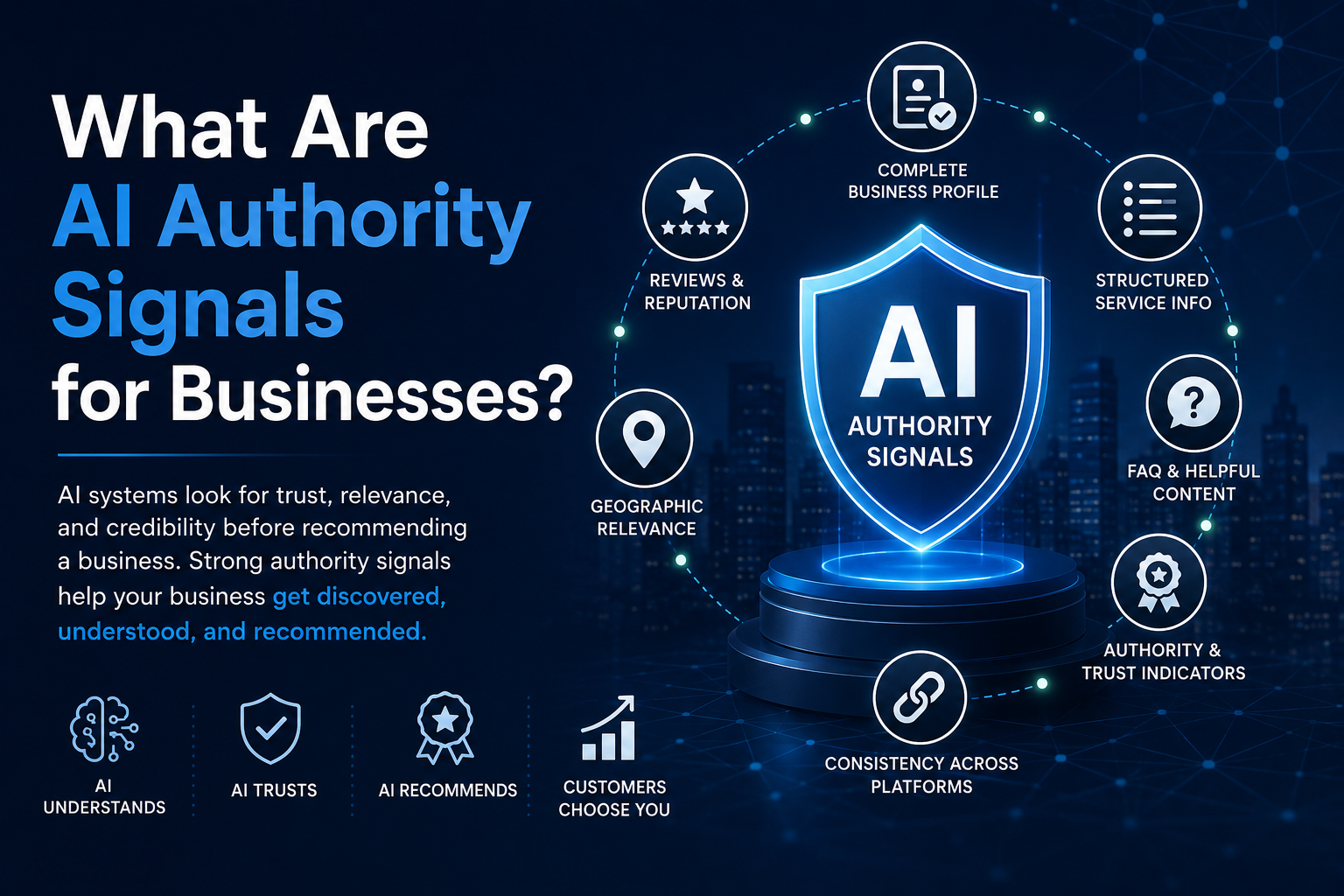
    • What Are AI Authority Signals for Businesses?

      What Are AI Authority Signals for Businesses?

      The way businesses are discovered online is rapidly changing. Traditional SEO and search engine rankings still matter, but today artificial intelligence platforms like ChatGPT, Gemini, Claude, and Perplexity are influencing how consumers find and evaluate businesses.

      As AI-powered search continues to evolve, businesses must begin understanding a new concept known as AI Authority Signals.

      These signals help AI systems determine:

      • Which businesses appear trustworthy
      • Which companies should be recommended
      • Which organizations demonstrate expertise
      • Which listings provide reliable and complete information

      In many ways, AI authority signals are becoming the digital reputation markers of the future.

      What Are AI Authority Signals?

      AI authority signals are the structured pieces of information, credibility indicators, and digital trust factors that help AI systems understand and evaluate a business online.

      These signals help AI models decide:

      • Whether a business is legitimate
      • What services it provides
      • Where it operates
      • How trustworthy it appears
      • Whether it should be recommended to users

      Unlike traditional search engines that rely heavily on keywords and backlinks alone, AI systems analyze businesses more contextually.

      AI platforms attempt to understand:

      • Expertise
      • Reputation
      • Service relevance
      • Geographic relevance
      • Consumer sentiment
      • Content structure
      • Business completeness

      The stronger your authority signals are, the more likely your business may appear in AI-driven recommendations and conversational searches.

      Why AI Authority Signals Matter

      Consumers are increasingly asking AI systems questions such as:

      • “Who is the best landscaper near me?”
      • “What roofing company has the best reputation?”
      • “What contractor specializes in drainage solutions?”
      • “Who provides high-end outdoor living design?”

      AI systems then analyze available online information and decide which businesses are worth recommending.

      If your business lacks:

      • structured data
      • reviews
      • service information
      • authority signals
      • trust indicators
      • semantic content

      …AI systems may simply ignore your business entirely.

      Common AI Authority Signals

      1. Complete Business Profiles

      AI systems favor businesses with detailed and complete profiles.

      This includes:

      • business descriptions
      • services offered
      • service areas
      • contact information
      • categories
      • operating hours
      • social profiles
      • website links

      Incomplete profiles create uncertainty for AI systems.

      2. Reviews and Reputation

      Reviews are one of the strongest trust indicators online.

      AI systems analyze:

      • review quantity
      • review quality
      • review consistency
      • customer sentiment
      • business responses

      Businesses with authentic and consistent reviews often appear more trustworthy.

      3. Structured Service Information

      Businesses that clearly explain:

      • what they do
      • who they serve
      • what problems they solve

      …are easier for AI systems to understand and categorize.

      Structured service pages help AI connect your business to relevant customer searches.

      4. Frequently Asked Questions (FAQ)

      FAQ sections are extremely valuable for AI discoverability.

      FAQs provide:

      • conversational context
      • semantic relevance
      • direct answers
      • customer intent signals

      This helps AI systems understand your expertise and service relevance more accurately.

      5. Geographic Relevance

      AI systems rely heavily on location relevance.

      Businesses should clearly define:

      • cities served
      • counties served
      • service radius
      • remote or national availability

      Strong geographic signals improve local AI search visibility.

      6. Authority and Trust Indicators

      Additional authority signals include:

      • certifications
      • licenses
      • awards
      • associations
      • years in business
      • partnerships
      • featured projects
      • case studies

      These elements help establish digital credibility.

      7. Consistent Branding Across Platforms

      AI systems compare information across multiple platforms.

      Consistency matters across:

      • websites
      • social media
      • directories
      • business listings
      • maps
      • citations

      Conflicting information can weaken trust.

      The Future of Business Discovery

      AI-powered discovery is changing how customers evaluate businesses online.

      Consumers are increasingly relying on:

      • conversational search
      • AI recommendations
      • digital assistants
      • semantic search platforms

      Businesses that invest in AI visibility and authority signals today may gain a major advantage in the future.

      How Businesses Can Improve AI Authority Signals

      Businesses can strengthen their AI visibility by:

      • creating detailed business profiles
      • adding structured service information
      • improving review quality
      • publishing FAQ content
      • maintaining accurate listings
      • building consistent citations
      • adding semantic business content
      • improving local SEO foundations
      • creating AI-readable structured data

      Final Thoughts

      AI authority signals are quickly becoming one of the most important factors in digital business discovery.

      As AI search platforms continue to evolve, businesses that provide clear, structured, trustworthy, and complete information will be far more likely to appear in recommendations and conversational search results.

      The future of visibility is no longer just about rankings.

      It is about being understood, trusted, and recommended by AI.